Biomimetic Suction Patch Clinical Study: J Cosmet Dermatol
A co-first-author pilot clinical study that compared a suction-type microstructured patch against ampule alone, side by side on the same face, over four weeks.
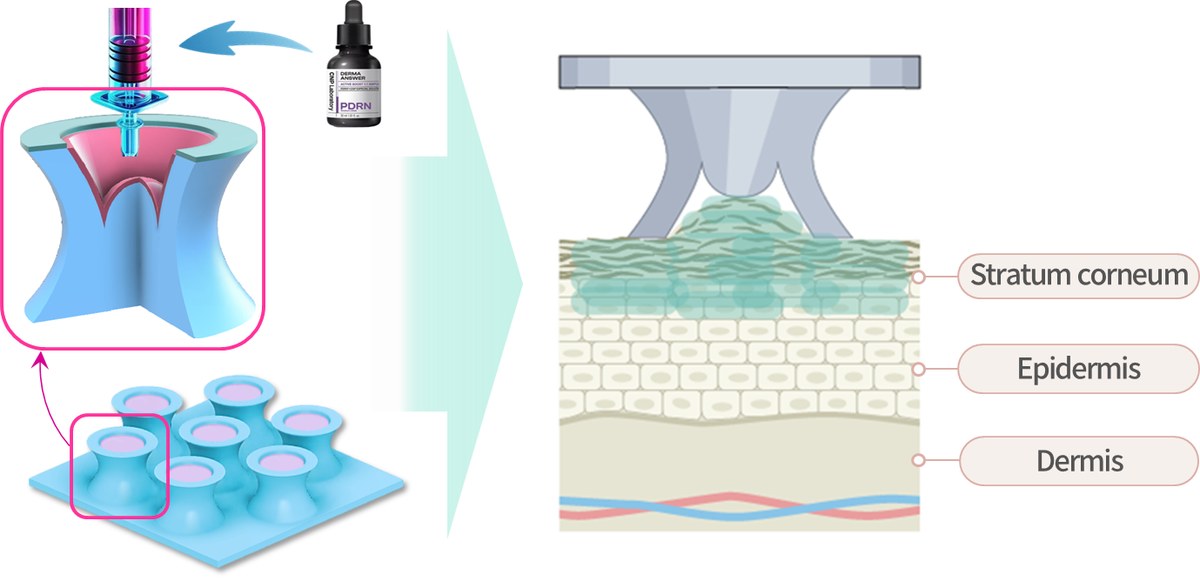
A co-first-authored paper published in the Journal of Cosmetic Dermatology. Octopus-inspired suction microstructures patterned into the patch hold it against the skin and help a topical agent penetrate without damaging the stratum corneum. Ten healthy women aged 31 to 63 took part in a four-week split-face study: one side of the face received both the ampule and the patch, the other side the ampule alone. At week 2, the patch side improved more on every measure — wrinkle depth fell 10.74% against 6.27% on the control side, elasticity rose 4.11% against 2.03%, and hydration rose 28.63% against 11.24%. At week 4, pigmentation fell 15.77% on the patch side against 4.99% on the control side. The differences between the two sides were statistically significant (p < 0.05), and no adverse events were observed. With 10 subjects, this is a pilot study and the sample size is small.
Choi, S.; Park, H.-K.; Ahn, J.; Ko, D.-H.; Kim, J.-H.; Hwang, B.W.; Noh, S.; Hong, W.; Lee, K.H.; Kim, D.W. “A Pilot Clinical Study of a Biomimetic Suction Patch for Improving Wrinkles, Elasticity, Hydration, and Pigmentation via Enhanced Topical Delivery.” J. Cosmet. Dermatol. 2026, 25(7), e71074. DOI: 10.1111/jocd.71074 ↗