What Would It Take to Reduce AMOC Risk? A Thought Experiment for AI and Space Infrastructure
The claim that a space sunshade could reduce AMOC risk remains unproven. This essay asks what would have to be observed and tested first.
Contents
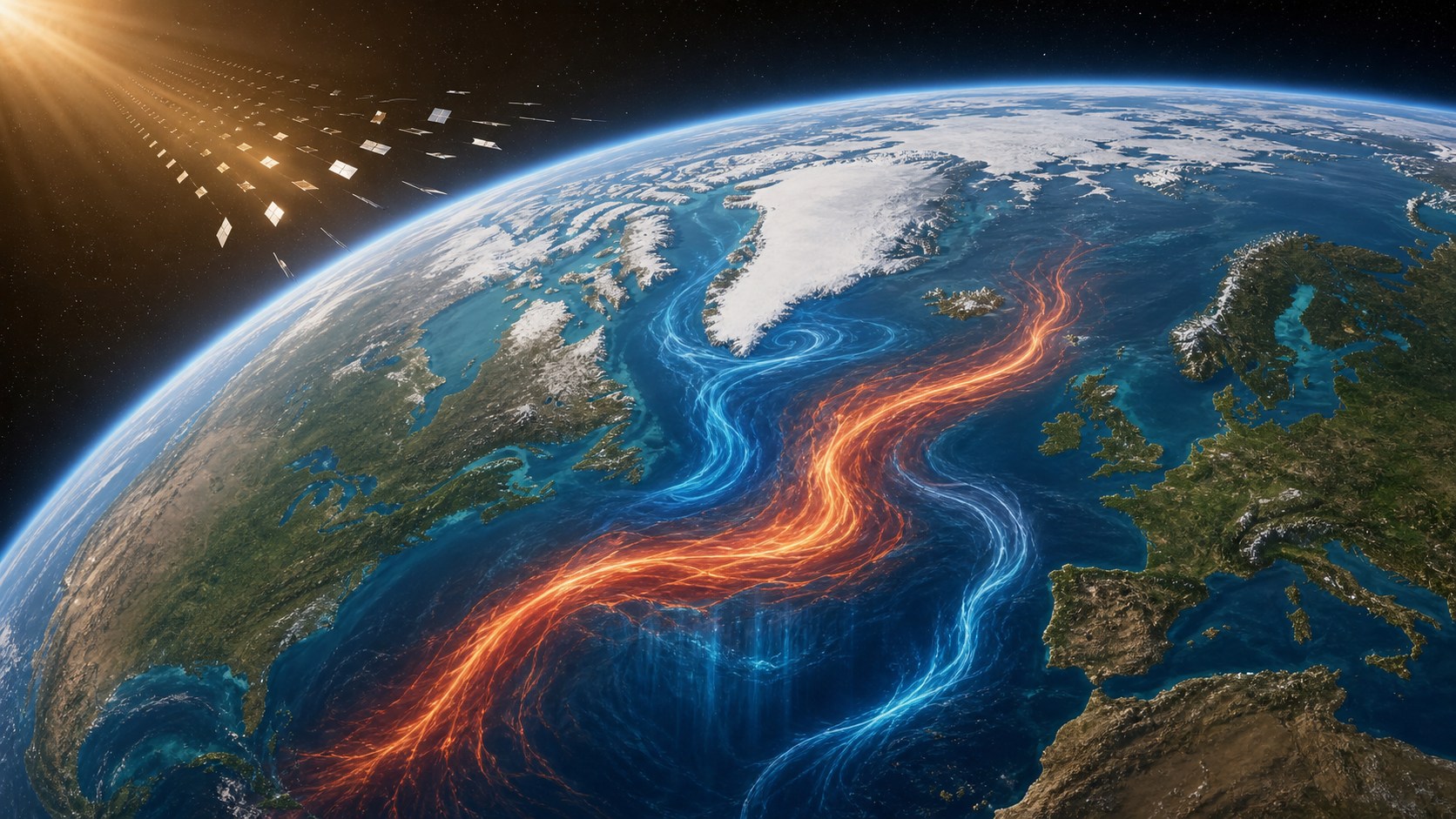
Reducing sunlight slightly may seem trivial, but it actually impacts the entire planet's climate system.
Begin with a thought experiment. Put many thin sunshade panels about 1.5 million km between the Sun and Earth. They might reduce total sunlight reaching Earth, but selective control of summer sunlight over the Arctic and Greenland has not been demonstrated.
At first, it sounds insane. A sunshade in space to cool Earth sounds like the kind of idea that has gone too far. But the more insane thing is already happening. We burned fossil fuels, changed the composition of the atmosphere, warmed the ocean, and reduced the white ice of the Arctic.
What worries me most is not Arctic ice by itself. A deeper ocean-current system is at risk. AMOC.
AMOC is the Atlantic’s giant current circulation
AMOC stands for Atlantic Meridional Overturning Circulation. The words are heavy, but the picture is simple.
Warm seawater moves north along the surface of the Atlantic. When it reaches the North Atlantic, it cools, becomes saltier, and grows heavier. That heavier water sinks. Then the deep water flows back south.
That current pattern is AMOC. It affects Europe’s climate, tropical rainfall, sea level, fisheries, and even the ocean’s ability to absorb carbon. NOAA describes AMOC as the Atlantic current system that moves warm water north and cold water south. The problem is that this circulation can weaken.
For water to sink well in the North Atlantic, two things matter. It has to be cold, and it has to be salty enough. Global warming works against both. The ocean warms, while melting Greenland ice and Arctic ice add freshwater. Freshwater has less salt. As the surface water becomes less salty and less heavy, the sinking flow in the North Atlantic weakens.
The Arctic is a control point, not the final destination
Cooling the Arctic is not only about protecting the Arctic. The Arctic is Earth’s white reflector, and one of the control points that can affect AMOC.
White ice reflects a lot of sunlight. Dark ocean absorbs it. When ice retreats and ocean appears, the ocean takes in more heat. Then the ice melts faster. That loop is frightening.
NASA explains that when Arctic sea ice decreases, Earth’s surface absorbs more sunlight. This is not an abstract future scenario. It is physics already underway. When the white cover disappears, Earth absorbs more heat.
That is why Arctic summer deserves close observation. In winter there is little sunlight, while sea ice and Greenland’s surface melt heavily from late spring through summer. Models and observations would first have to show how reducing radiation in that period changes heat and freshwater entering the North Atlantic.
A space sunshade is a temporary climate response
Proposals for reducing incoming sunlight include dispersing particles in the stratosphere, brightening clouds, and placing equipment in space. Researchers have not established which approach would be safest or easiest to reverse. Any proposal must account for effects on the atmosphere, oceans, and ecosystems, as well as the risks of stopping it.
Imagine small shade modules near L1 between the Sun and Earth. L1 is a special point about 1.5 million km from Earth. ESA describes it as one of the Lagrange points where the gravity of the Sun and Earth balances in a useful way. From there, many thin membranes could dim sunlight by a tiny amount.
A modular design with many small shades is one proposal. Changing their angle might adjust total shading, but the required precision and long-term orbital stability have not been demonstrated.
Whether repeated deployment or angle control would be safer is itself an engineering question. Membrane durability, attitude control, solar pressure, and failure recovery all need testing before one design can be called safer.
This idea is not completely new. In 2006, Roger Angel published a paper proposing a cloud of small spacecraft near L1 to reduce sunlight by about 1.8%. The James Webb Space Telescope also launched folded and then deployed mirrors and a sunshield in space. A climate-scale system would be much larger and harder than Webb, of course. But the basic idea of launching thin folded structures and deploying them in space is already inside space engineering.
Still, we should not treat this device as the final solution to the climate problem. Reducing sunlight does not remove CO2. It does not solve ocean acidification. If we keep burning fossil fuels, the problem grows again.
A space sunshade is not a demonstrated solution. It is an early proposal for reducing incoming solar radiation, and any effect on AMOC risk would have to be established through models and observations. The immediate priority remains cutting CO2 emissions and removing CO2 already in the air.
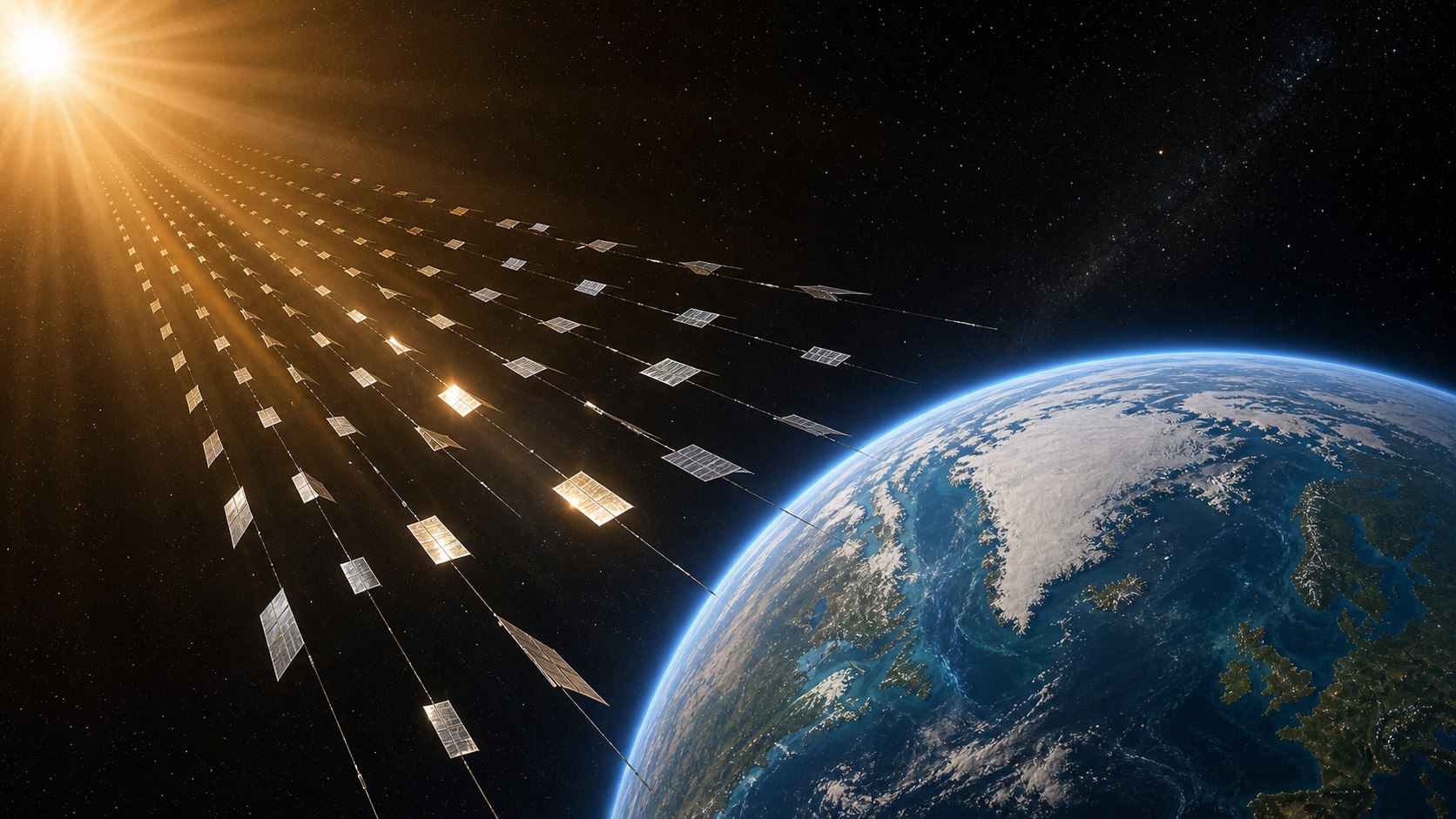
Space sunshades can slow temperature rise, but unless greenhouse gas emissions are reduced, the problem of global warming remains.
Slow temperature rise first, then reduce CO2
A space sunshade cannot reduce CO2. The research question is whether it could slow additional heat entering the Arctic and North Atlantic without creating larger harms.
Even if observations show AMOC weakening in a dangerous direction, models and limited tests would have to establish the effects and side effects of any intervention. Emissions cuts and CO2 removal must proceed independently of that research.
The order matters. If we turn on a space sunshade but fail at CO2 removal, additional heat input rises again when the shade is reduced. Then a temporary response becomes a dependency that has to be maintained.
So there has to be an exit plan. We need to know how much shading to reduce when CO2 concentration falls, and how to lower Arctic summer shading when AMOC observations recover. Shading has to be tied to verified CO2 removal. If the two move separately, the system becomes dangerous.
AI should keep observing AMOC and calculating risk
This is where AI becomes necessary. The job of AI is not to draw impressive space concept art. Its job is to keep watching AMOC, predict risk, and calculate the scale of sunlight reduction.
There is too much data to watch. Arctic sea ice area and thickness. Greenland surface melt. Temperature and salinity around the Labrador Sea, Irminger Sea, and the Nordic Seas. Freshwater input into the North Atlantic. Clouds and rainfall. Mid-latitude weather swings. How much carbon the ocean absorbs. How much CO2 removal actually works.
A few people cannot judge all of this by instinct. Satellites, ocean buoys, ground sensors, ship observations, climate models, and carbon accounting must be considered together. AI can help identify changes quickly and compare several scenarios. Decisions about how much sunlight to reduce and who should bear the risk cannot be made by AI calculations alone.
AI should not become an all-powerful ruler that governs Earth for us. But it can take on the role of pointing out signals too complex for humans to see alone.

The AI observation network does not stop at just guessing the forecast, but also allows us to more quickly identify climate changes that humans would notice later.
SpaceX should look at Earth’s ocean circulation before Mars
If any company can turn this kind of work into real industry, SpaceX is one of the first names that comes to mind. It launches rockets often, operates satellites at scale, and builds space infrastructure at industrial scale. The first use of that capability should be Earth’s climate emergency network, not a Mars city.
We need a dense climate observation satellite network. We need stronger ocean observation for AMOC. We need small space sunshade module tests, including solar pressure, attitude control, and long-term durability. AI models need to keep receiving that data and calculating from it.
Mars can wait. If AMOC collapses, Earth’s currents, rainfall, agriculture, and sea level move first. If rockets are truly a technology for civilization, their first cargo should not be parts for a Mars city. It should be equipment that observes and protects Earth’s ocean circulation.
AI data centers need to carry responsibility
To accelerate AI, we need more computation. That means more chips, more electricity, and more cooling. Here the contradiction appears. If AI claims to help solve global warming while running on fossil-fuel power, the story does not hold.
AI data centers need conditions. They should run on carbon-free power. They should disclose the burden they place on the grid. They should disclose water use. And a significant part of their compute resources should go to climate problems.
If the AI industry wants social permission to grow, it has to prove this: yes, we use a lot of electricity, but we use it to solve humanity’s biggest problem. That proof has to be results, not slogans. AI has to lower the cost of CO2 removal, stabilize power grids, cut industrial emissions, and predict AMOC risk better.
If it cannot do that, AI acceleration becomes too small and too luxurious a game.
Saving AMOC is the first big task of the AI age
There is still uncertainty about when and how much AMOC will weaken. A public essay should not claim that collapse is imminent as if it were settled fact. The IPCC expects AMOC to weaken during the 21st century, but it rates an abrupt collapse before 2100 as unlikely. At the same time, recent studies warn that models may underestimate the risk and the degree of weakening.
This is not the kind of risk to dismiss by looking only at probability. If the damage is enormous when it happens, you buy insurance even when the odds look small. AMOC is that kind of problem. If it stops, it is hard to restart, and its effects do not stay inside one region.
The climate goals of the AI age should go beyond one global-average temperature number. We need precise observation of the Arctic, Greenland, and the North Atlantic, along with rapid emissions cuts and CO2 removal. Space sunshades belong in research on effectiveness, side effects, and governance, not in the category of proven emergency tools.
The core is not the fantasy of blocking the Sun. The core is keeping the Atlantic current circulation from stopping.
The first reason to build stronger AI should not be AI itself. More ads, cheaper content, and faster automation are not enough. Goals that small cannot justify the electricity, capital, and talent humanity is pouring into AI.
AI should be used not only for advertising but also for AMOC observation and climate-risk analysis. Rockets and satellites can contribute to monitoring ocean circulation. The task now is to observe AMOC more accurately, forecast risk, and clearly separate unproven interventions from emissions policies that can be implemented today.