How to Earn Trust in Politics: Keep Promises Instead of Faking It
Politics moves emotion and sides before logic. A person who cannot fake warmth should earn trust by making small promises and keeping them.
Contents

People who are not good at empty words must earn trust by making small promises and actually keeping them.
When I lie, it shows all over my face. Praise I do not mean, and soulless diplomatic lines, do not sit well in my mouth. If I force them out, I become uncomfortable first, and my expression breaks down before anything else. But politics is the work of winning people’s hearts. Often you have to say what many people will like, what they want to hear, what reassures them right now. So is a person like me, who cannot make empty talk, simply unsuited to politics?
I thought so for a long time. But the deeper I looked, the answer was a little different. A person who cannot make empty talk can still win people’s hearts. They just have to move away from deceiving with words and toward promising and keeping.
People ask who is on their side before they follow logic
In politics, people do not read the policy table first. They ask first: is this person on our side? Do they know my pain? Do they speak my anxiety for me?
This does not mean policy is unimportant. But policy is usually understood late. Emotion reacts first. When someone feels like my side, I then try to understand what they say. When someone does not feel like my side, I hear even a good policy defensively.
So a politician’s popularity does not come from logic alone. It starts from emotion and identity. People are moved first not by “who is accurate,” but by “who recognizes me.”
The words that build popularity have a structure
The words that win people’s hearts have a repeated structure. First they recognize the pain: “I know you are struggling.” Then they point to the cause: “There is a reason for that pain.” Finally they give a direction: “We can change it this way.”
A bad politician makes an easy enemy here. They push a complex problem onto someone’s fault. People react faster to a sharp enemy than to a complex explanation. When the enemy is clear, anger gathers, and when anger gathers, support grows quickly.
But good politics also has to win people’s hearts. The difference is whom it takes as the enemy. Taking groups of people as the enemy becomes division. Taking problems such as corruption, waste, inefficiency, and irresponsibility as the enemy becomes politics that can be fixed together.
Politics is in the end the work of setting the direction of emotion. Anger can be aimed at people, or it can be turned toward solving problems.
Good policy does not get known on its own
Good policy is usually complex. Its effects come late. Education, health care, infrastructure, science and technology, and administrative reform do not produce results in a single day. Anxiety and anger, on the other hand, move right away.
So good politics gets a raw deal. The more genuinely helpful a policy is, the longer its explanation, the later it is felt, and the louder the people who oppose it. The many who benefit are quiet, and the few who lose resist hard. So a good politician must not only make good policy. They have to turn that policy into words people can feel. They have to turn numbers into a person’s face, and a distant future benefit into a small change people can feel now. A 2% drop in unemployment is weaker than one day of a person who got a job back. People react first to a concrete life, not to a statistic.
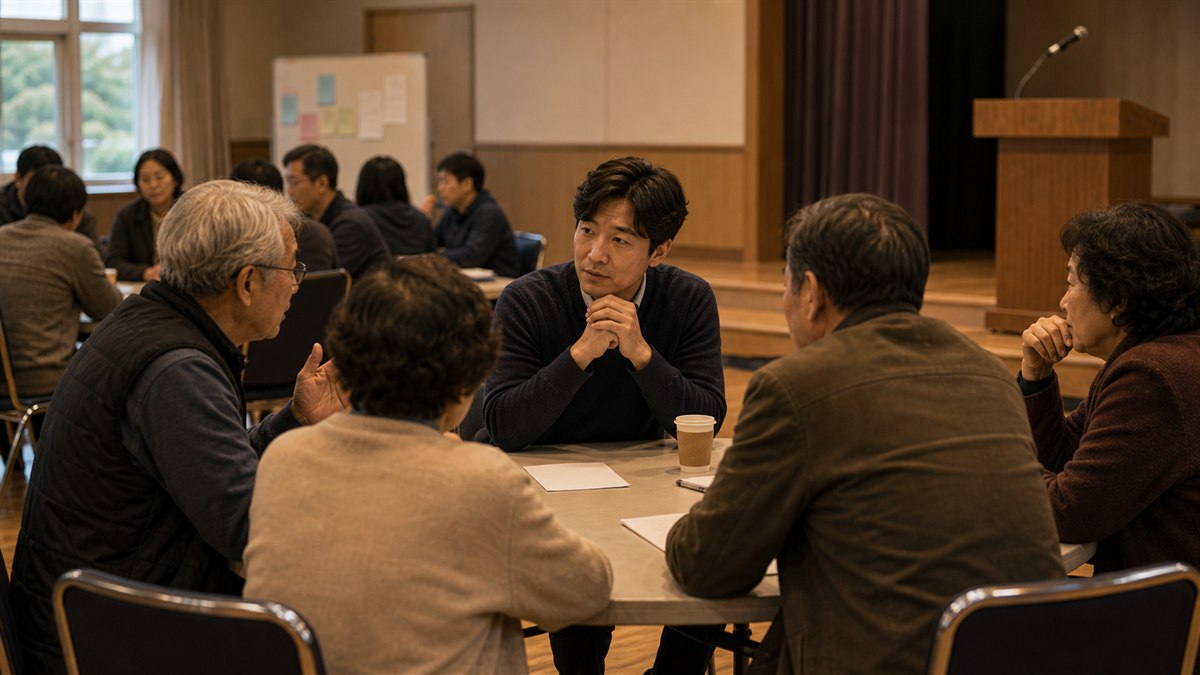
Policies are designed based on numbers, but citizens judge the policy by how it changes their day.
Winning popularity and doing the work are different abilities
The ability to win votes and the ability to get the work done are different. In an election you have to speak hope to many people. In governing you have to set priorities and say that what cannot be done cannot be done. In an election, making many promises can sometimes help. But administration runs only when you cut promises and execute. Elections use the language of emotion, and administration uses the language of responsibility. So a person who speaks well does not necessarily do the work well. The other way around, a person who does the work well does not necessarily win votes well. They are different abilities.
To enter politics you have to admit this difference. You have to know whether you are a person who wins hearts or a person who actually keeps the work running. If it is hard to do both well alone, you have to keep someone beside you who fills the weaker side.
A person who cannot fake warmth has trouble winning people quickly with words
A person like me is at a disadvantage in politics that pushes ahead quickly with words. It is hard to flatter the other side on the spot, scatter pleasing words, and throw out vague promises with confidence. It shows on my face.
But this weakness becomes an asset in another way. In a place where everyone can make empty talk, the value of words drops. Anyone can say, “I will do this for the people.” So people do not believe that line as it is.
But the promise of a person who cannot lie well is a little different. That person has a clear boundary between what they can say and what they cannot say. They cannot easily say that something impossible is possible. So over the long run they look, instead, like a person worth trusting.
A person who cannot make empty talk is not someone who wins by talking a lot. They win by talking little and keeping what they said.
Honesty is not a manner of speaking but a repeated record
The image of being honest is not created by saying “I am honest.” It is created from a repeated record: promising only what can be done, keeping what was promised, admitting when wrong, and fixing it again. If you cannot give empty praise, you can make an accurate observation. Instead of you are wonderful, you can say holding that clause to the end in that negotiation was what mattered. Do not decorate words you do not mean; say exactly what you actually saw. Say you do not know when you do not know, and say you will not answer now what you cannot answer now. Not every silence is a weakness. Sometimes a kept silence is better than words filled with lies.
A person who cannot make empty talk does not need to copy a flashy manner of speaking. They have to turn the reliability of their words into an asset.
Promise Less and Keep It
Politics is in the end the work of winning people’s hearts. But there is more than one way to win hearts. Some people gather anger and rise quickly. Some people keep their promises and build trust slowly.
A person like me loses in the way that deceives quickly with words. But in the way that builds trust slowly, it is worth a try. I have to go in the direction where record gathers over words, results gather over image, and kept promises matter more than empty talk.
Emotion cannot be avoided in politics. People move by emotion. But there is no need to use emotion to deceive. You only have to turn real results into language people can feel.
So if you cannot make empty talk, do not try to learn it. Instead, promise little, keep it for certain, and make people feel what you kept. People’s hearts can be won with words too. But the hearts that last are in the end won by record.