No Company Has Made Money With AI? The Question Is Too Early
AI has not deeply entered field work yet.
Contents
To judge AI profits, you need to look not only at model companies, but also at how infrastructure, power, and data providers make money.
Read enough AI investing articles or watch enough YouTube commentary, and the same question keeps coming up.
“So, has any company actually made money with AI?”
At first, I thought this question would be easy to answer. The more I think about it, the less simple it becomes. The phrase “making money with AI” mixes several different stories into one sentence.
Has a company that sells AI infrastructure, like NVIDIA, made money? Yes.
Has a frontier model company like OpenAI or Anthropic proven stable profitability? That is a much more careful question. Revenue is growing fast, but data center and compute costs grow with it. Bringing in a lot of revenue is not the same thing as running a business that reliably keeps cash.
Has a normal company used AI to lift company-wide profit in a visible way? That question needs more time. Many companies have not rebuilt work around AI. They are still attaching AI to the side of the work they already do.
So when people ask, “Where are the companies making money with AI?”, the question is a little early. Most AI we see today still works best when a human is sitting in front of a computer.
AI outputs get cheap fast
AI can produce a report draft. It can also make an image, write code, or draft an email.
All of that is useful. It is genuinely convenient. But those outputs become common very quickly. Everyone can open the same window, ask a similar question, and get a similar answer.
It is hard to build a lasting business by taking the output of a few prompts and shipping it as-is. Other people use the same tools. A single AI draft does not stay differentiated for long.
The difference that can turn into money is decided in the work after that.
A person reads the AI draft again. They compare it with real data. They watch how customers respond. They fix the parts that break in the field. They send that back into AI. Then they judge the next output again. They revise, add evidence, and change direction several times.
The result is different. Someone who only ran AI once cannot easily catch up. A person reread the AI output, compared it with real data, and fixed it in the field.
Making money with AI does not mean selling whatever AI produced on the first pass. It starts when AI is pushed all the way through what it is good at, and humans move upward into the harder judgment.
Companies have not rebuilt work around AI yet
Many companies have not reached that point.
They put a chatbot into the workflow. They summarize meetings. They draft customer support replies. Developers use coding assistants. Even that raises productivity. But it does not transform the whole company.
If the approval process is unchanged, AI may produce the result quickly, but the time to approval does not shrink. If data is scattered, AI cannot gather the evidence it needs for decisions. If no one has clear authority to revise AI output and apply it to field systems, the output does not get used in real work. If evaluation standards stay the same, people use AI to make old reports faster instead of creating new ways to work.
Using AI well requires the order of work, the flow of data, responsibility, and review to change together. This is not just installing one more tool.
So it is not strange that AI’s effect takes time to show up in the profit line of ordinary companies. Many organizations have not redesigned work around AI yet. They are still testing AI on top of the old workflow.
The real question is whether field sensation can reach AI
The bigger difference appears here.
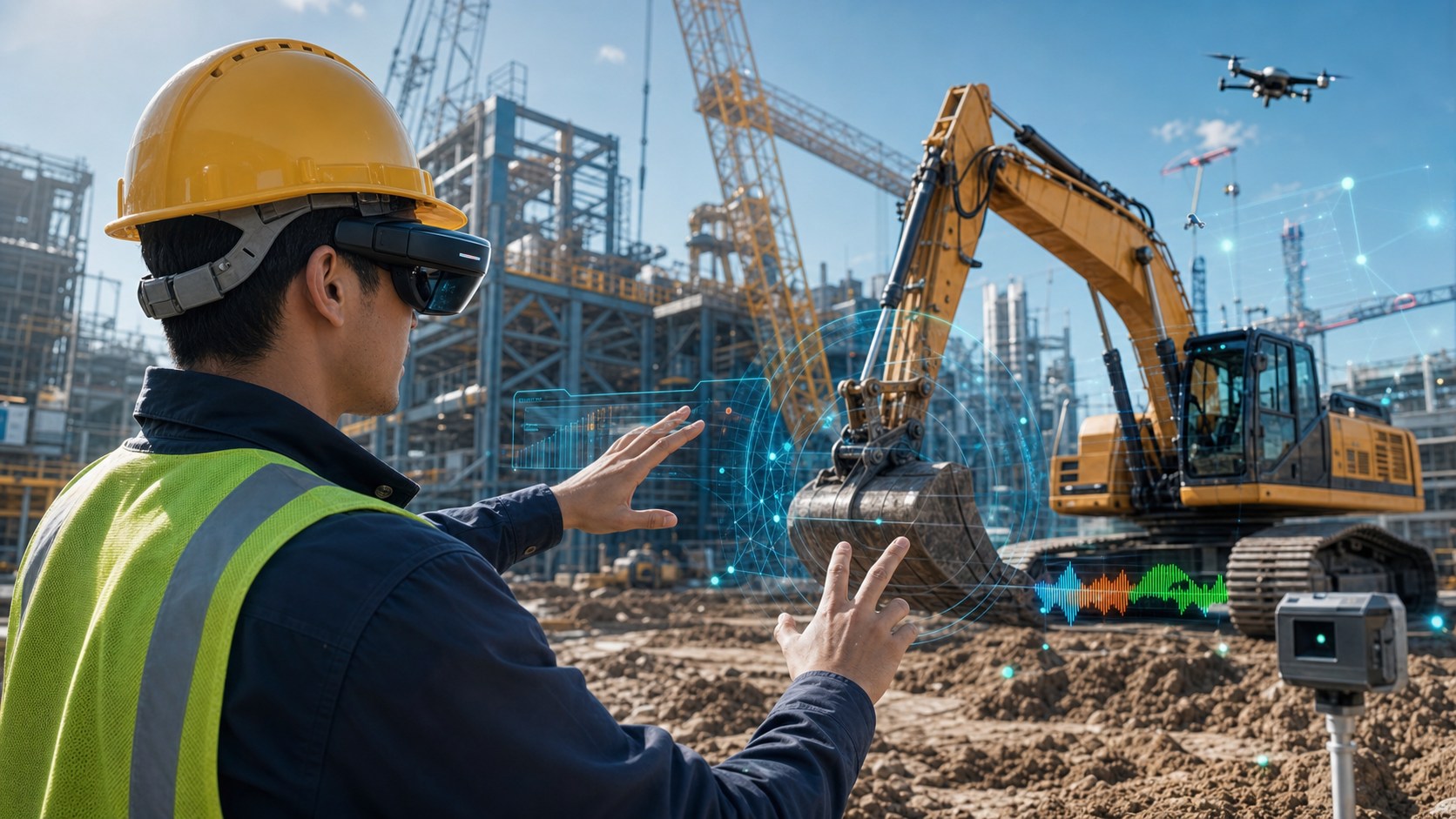
Does AI-enabled work still require a person to sit in front of a computer? Or can a person use a wearable AI device in the field, call it up immediately, and share what they see, hear, touch, and notice?
That difference matters.
In a factory, a person needs to call AI while looking at the machine. In a lab, they need to compare a sample with previous conditions while it is still in front of them. The same is true in hospitals, warehouses, stores, and sales meetings. The key information for work is not only in documents or code. It is also in the machines, samples, and customer reactions in front of the person.
The current pattern of “let me go back to my desk and ask AI later” has a ceiling. Field judgment happens on the spot. You see, hear, touch, talk, and decide right there.
A camera is not enough. The field contains information the eye alone cannot capture. A machine sounds different from usual. A surface pushes back differently under the hand. The air smells or feels different. A person’s tone and expression are off. The person at the site often senses these first.
For AI to handle real work, it has to receive information from the moment the work happens. And the human has to be able to transmit what the body senses into AI as much as possible. Only then can AI judge the situation in front of it, not just documents and tables.

Only when field data is available can AI move beyond report writing and provide evidence for real decisions.
If you only think about robots, you miss the important part
When people imagine AI entering the physical world, they often jump straight to robots. AI gets a body, walks, grabs, moves, drives, and replaces human motion.
That path matters. But if you only look at robots, you miss the important part. The physical world already has a body in it. The human body.
There is a more immediate path in between: people use AI through wearable devices.
Glasses, earbuds, cameras, microphones, location sensors, motion sensors, temperature and pressure data, and equipment data connect to AI. AI sees and hears alongside the person. It knows where the person is, what they are looking at, and how the current scene differs from past records.
Then the human moves. They operate equipment, meet customers, check samples, adjust spaces, and make decisions. AI records, compares, and suggests the next move from the side.
This is not the same story as robots replacing humans. It is the story of the human body becoming the interface for AI.
AI has not deeply entered field work yet
So the question “Which company has made money with AI?” is only half right.
It is true that many companies still have not shown large profit gains. But it is too early to say AI has already revealed its limit. In many places, AI is still used first for computer-based work: documents, code, tables, images, search.
The real change begins when AI enters the field. Can a person use AI only when sitting at a computer? Or can they call it up while wearing it at the site? Even further, how well can they transmit what they sense in that moment into AI?
That difference will shape the next productivity gap.
While AI remains a tool used in front of a computer, the contest looks similar. Everyone types into the same window and receives similar answers.
The gap opens when AI becomes a tool people can use directly in the field. When people use wearable AI devices to see, judge, and act more effectively, the meaning of “making money with AI” changes too.
Sources
- NVIDIA, NVIDIA Announces Financial Results for Fourth Quarter and Fiscal 2026.
- OpenAI, A business that scales with the value of intelligence.
- Anthropic, Anthropic raises Series H to accelerate enterprise, developer, and international growth.
- Deloitte, The State of Generative AI in the Enterprise.
- Gartner, Gartner Predicts Over 40% of Agentic AI Projects Will Be Canceled by End of 2027.