AI Beat Go. Why Is Welding Still Hard? Humans Stop, Machines Repeat
Humans infer danger from a few clues and stop. Machines repeat many times, compare scores, and learn.
Contents
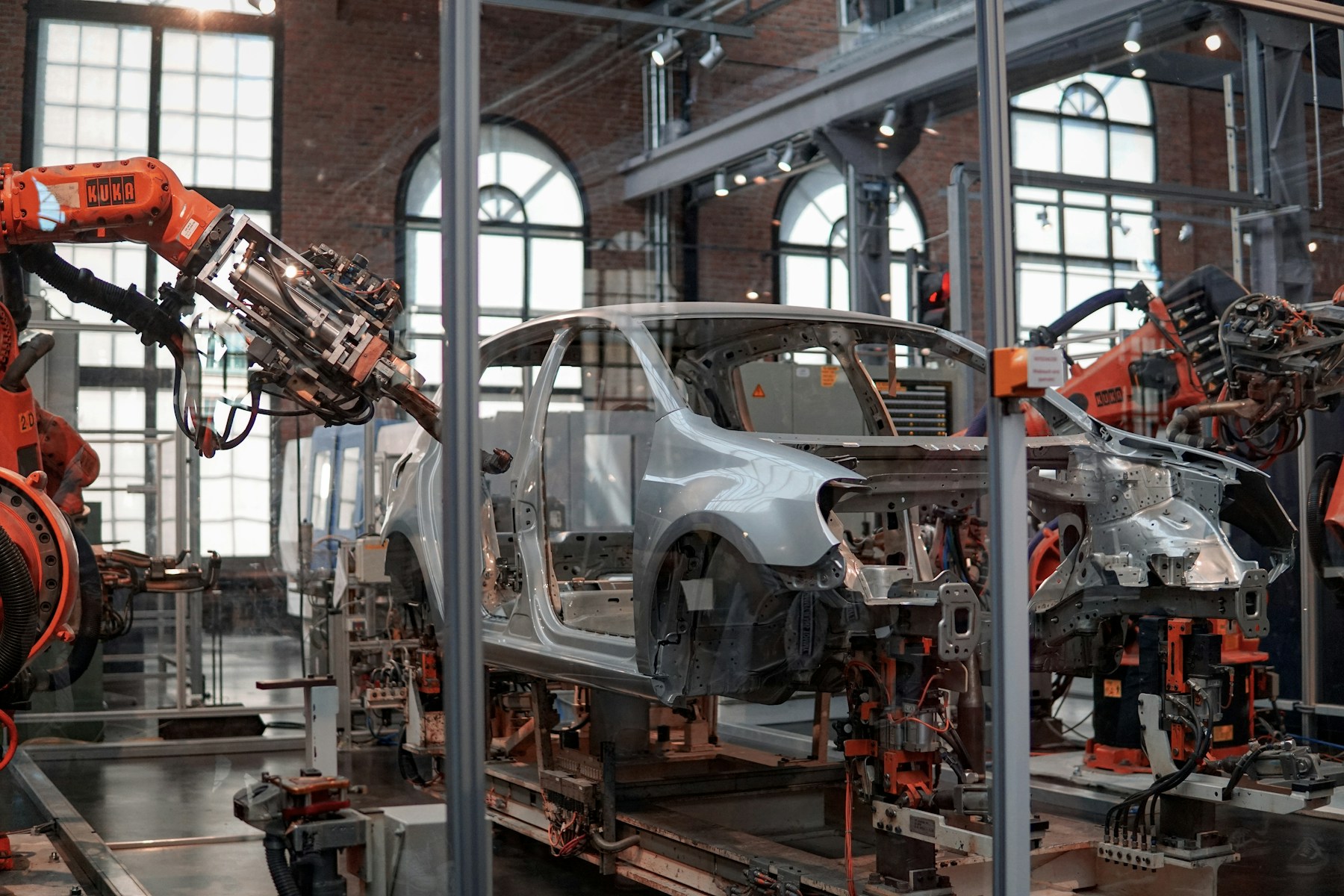
Baduk AI can learn in a space with fixed rules, but in a factory, risks and responsibilities are not organized by numerical scores alone.
Whenever people talk about the AI that beat the world’s best Go players, the same question comes up: “At this level, isn’t it about to take every human job?”
But the picture changes when you go to the field. AI beat Go, but welding is still not easy. It can solve coding problems, but it cannot yet do sparking welds beside old pipes with the same stability as a person.
This difference is not simply a question of which one is harder. The deeper difference is in how humans and machines learn. Humans can infer causes from limited experience and stop when something looks dangerous. Current AI is strongest when it can try many times, compare results, and find the direction where the score improves.
Go is a world machines can learn well
On a Go board, the world does not break when you place one stone badly. If you lose a game, you play again. The result comes quickly. You know soon whether you won or lost, and by how much.
For AI, these are almost perfect learning conditions. It can try endlessly, fail, and correct itself. While a person plays a few games, the machine can play millions against itself. Failure is cheap, results are quick, and repetition is nearly unlimited.
Reinforcement learning is, in simple terms, this structure. Try many times, keep the good choices, reduce the bad choices, and improve little by little. In problems like Go, which can be run endlessly inside a computer, AI becomes strong quickly.
This is not because Go is easy. Go is very difficult for humans too. But from the machine’s point of view, it is a world where failure is almost free. AI can make mistakes there as much as it wants, and learn every time.
Welding is a world where machines cannot freely fail
Welding is different. One attempt already costs something. It costs material, equipment, and time. Metal melted incorrectly cannot be reset like a Go board.
The larger problem is danger. A failed weld is not just a wrong answer. It can lead to an accident. It may look fine on the outside while a defect is hidden inside, and that defect may appear months later.
Then the learning structure machines like breaks down. They need many attempts to learn, but they cannot fail many times. They need fast results to correct themselves, but the results come late or only partly show. The most important failure data can be too dangerous to create deliberately.
In Go, you can make a million bad moves. In welding, you cannot make a million bad welds. That is why automation that handles real equipment is slower than automation where you can check documents, code, and logs, then fix them again.
Humans infer causes from a few clues
Skilled workers do not learn by failing a million times. Of course they have to spend a long time doing and seeing many things. But the human strength is not experiencing every possible case. It is inferring causes from a few clues, remembering similar situations, and stopping when something looks risky.
For example, a welder watches sound, smell, the shape of sparks, and vibration in the hand at the same time. If something differs from usual, they become careful even without exact numbers. They judge, “This looks dangerous,” slow down, or stop the work.
This is not mystical intuition. Humans learn through the body in the real world. They already have a basic sense that fire is hot, metal bends, equipment ages, and people make mistakes. So even in a new situation, they pull from past experience, build a rough cause, and act.
Humans make hypotheses even without perfect data. This sound may be a temperature problem. This vibration may mean the fixture is loose. This smell may mean the material changed. They may be right or wrong, but at least they can stop in front of danger.
Machines learn from many seen patterns and scores
Current AI, by contrast, is generally strong at patterns it has seen a lot. If it sees many photos, it classifies photos well. If it sees many sentences, it predicts the next sentence well. If it runs many games, it finds winning choices well. The strength is clear. It sees volumes no person sees in a lifetime and repeats more times than a person ever could.
But this method needs conditions. The system must be able to try. It must be able to measure results. It must be able to give a score for what counts as a good result. Go fits these conditions well. Welding does not.
In real-world work, the goal is not simple. It is not enough for a weld to look good. If it looks fine now but breaks months later, it failed. Finishing quickly matters, but safety, durability, and cost matter too. Turning all of that into one score is difficult.
So machines can become strong in average situations. They learn quickly in common conditions, repeated tasks, and work where results are immediately visible. But weaknesses remain in rare signals right before an accident, exceptions outside the model, and risk judgments that are hard to score.
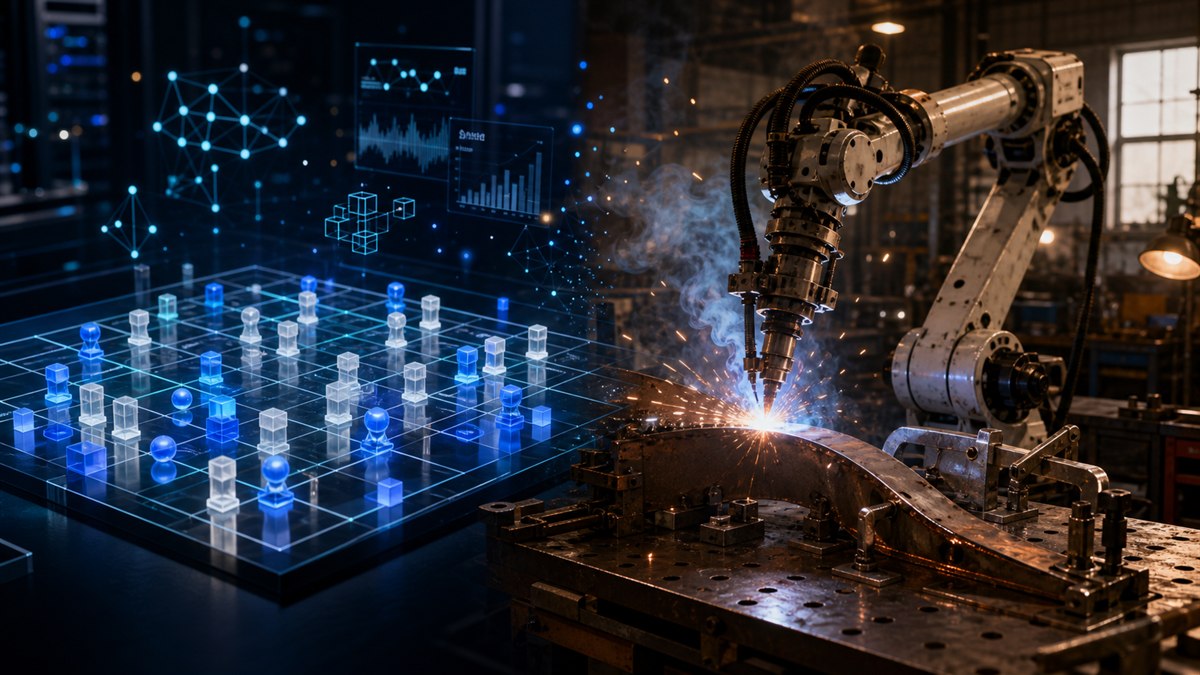
The more times a machine tries, the more clearly a person has to specify the conditions under which it should stop trying.
Digital twins give machines a practice field
This is where digital twins become important. A digital twin implements a real factory, equipment, materials, and work conditions in virtual space as closely as possible. Failure is expensive in reality, but in a virtual world the same failure can be repeated much more cheaply.
AI tries countless times inside that virtual world. It changes temperature, speed, angle, pressure, and material conditions, fails, corrects, and finds a better method. It does not immediately spread the method across the entire field. It first tests it on one real piece of equipment.
If it succeeds there, more data accumulates. The system corrects where the virtual world and reality differed, and finds more reliable conditions. Then it expands to the same equipment, same process, and similar sites. A method verified in one place spreads to others.
This is powerful. AI can experience far more cases in a virtual world than one human can in a lifetime. So as digital twins become precise and sensors become dense, there is a good chance AI will outperform humans in many real-world tasks too.
Still, the virtual world is not exactly the real world
But there is a limit here too. A virtual world cannot copy reality perfectly. Tiny differences in material, the habits of old equipment, workplace humidity, small human mistakes, and unusual failures keep appearing outside the model.
No matter how well AI performs in the virtual world, the points where virtual and real diverge require verification again. A method that succeeds virtually must be checked for safety in reality. Try it on one real machine, and only then expand if there is no problem.
This is where the strength and limit of machine learning appear together. Machines become frighteningly strong in worlds that can be repeated many times. But if that world resembles reality incorrectly, they have practiced the wrong thing many times. More important than the fact that it learned a lot is what it learned against.
Humans and machines fail in different ways
Humans fail too. Skilled people misjudge, make mistakes when tired, and miss danger signals because they are too used to the work. There is no need to turn humans into sacred beings.
But humans and machines fail differently. Humans can jump to a conclusion too quickly from a few clues and be wrong. Machines are strong inside patterns they have seen often, but once they leave the world they trained in, they can carry a strange confidence.
Humans feel uneasy when they do not know. So they stop, ask, or look again at the surroundings. A machine may not even know that the situation is unfamiliar. If the score and pattern look plausible, it can output an answer even when the real situation is dangerous.
So in real-world automation, performance alone is not enough. We have to ask when it performs well, when it does not know, and when it should stop. Even if the day comes when AI welds well, we still have to keep checking under what conditions it learned and how far it can be trusted.
The people who become expensive will connect the two learning methods
Then are skilled workers safe? It is hard to say they are safe forever. Once fingertip feel is moved into data, digital twins become precise, and real verification loops are built, automation enters that field too.
So the people who become expensive are not simply those with good fingertip sense. They are the people who can translate that sense into data. They know the field, know which sensors should be attached, know which failures matter, and know which records become learning data later.
This person connects the human learning method and the machine learning method. Humans infer causes from a few clues and stop when danger appears. Machines repeat many times and become stronger by comparing scores. The two methods are different, and both have strengths and weaknesses.
AI beat Go, but welding is still hard. Go was a world where machines could fail freely. Welding is a real world where every failure carries a cost.
But once digital twins, sensors, and real verification are connected, the story changes. AI can repeat endlessly in the virtual world, check on one real machine, and expand a successful method to other sites.
So the real question is not “Is AI smarter than humans?” The real question is this: who will turn the sense humans learned from a few clues into a structure machines can learn through repetition?
The person who does that becomes the expensive person of the next era.