You Can Prepare for a US PhD on Your Own
Eighteen months, from someone who knew nothing except that you needed a TOEFL score, to a full-funding offer.
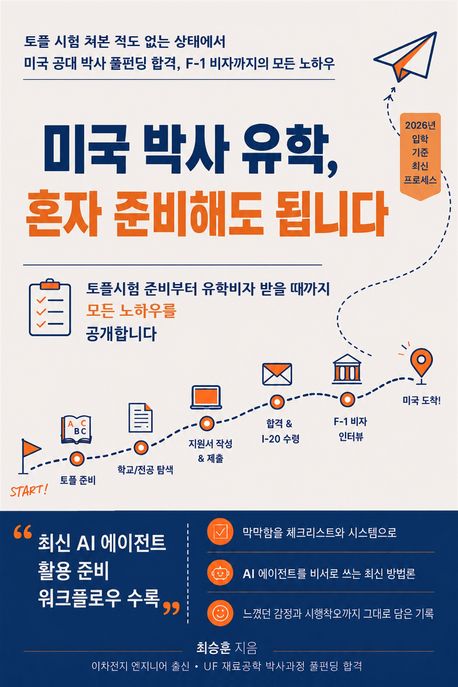
By Seunghoon Choi · Published by Bellunix · June 2026 · Written in Korean
eBook (ePUB) · KRW 16,000
The Map I Never Had
It was only when application season was right on top of me that I found out there was another important document for admissions, something called an Academic Statement. It was not in the basic bundle of documents I had been putting together.
I drafted it with ChatGPT, then revised it on my own, testing whether the logic held together. And once it was done, I understood something: this was a thing I could do.
It was the same after I finished applying and started hearing from schools that I had been placed on a waitlist. A waitlist did not look like a place to wait. It looked like a place to move. So I followed my own judgment and sent contact emails to every professor, and thanks to those emails I actually got interviews.
Let me start honestly. When I decided to pursue a PhD in the US, I knew nothing. Thirty-four by Korean reckoning, sitting at my desk one day at the office, I asked myself, “What do I need in order to go to the US for a doctorate?” Nothing came to mind. Truly nothing.
I did not know how to write a Resume. I had to look up what an SOP even was, that it was a statement of purpose. How schools are chosen, how you find a professor, what you do once you find one, and before any of that, whether I was even qualified to apply. I could not so much as organize the questions. The internet overflowed with information, but all of it was in fragments. Nowhere was there a map that showed, on a single page, what to do, in what order, and how far.
To put the conclusion first: I did it. I took the TOEFL, chose schools and professors, read those professors’ papers and sent contact emails, did Zoom meetings, wrote my SOP, got in, and passed the F-1 visa interview as well. A materials engineering PhD program at the University of Florida (UF), fully funded.

Let me be clear up front. What this book holds is only my own experience from one US PhD preparation process. I am simply setting down what I went through, just as it was, and showing the route that was possible on my own. The judgment is the reader’s to make.
That is why I am writing this book. The know-how I bought, and the experience I learned by finally running into things myself even after paying, I mean to lay out in full, all of it, for the price of a single book.
I will not write only about what I did well. For example, I started by studying for the GRE (the Graduate Record Examination, a test used only when applying to US graduate schools). I even enrolled in a prep course. Only afterward did I learn that the schools I would apply to did not require the GRE. And one more thing: a prep course is not run at your level, and if you were able to follow the lectures, you would not have needed the course in the first place. I write these missteps down just as they were. Success stories are impressive, but what mostly saves a reader’s money and time are the stories of failure.
There is one thing I should note. Because I have a career as an office worker, stories from work come up here and there in this book. But this book is not only for office workers who want a PhD. Whether you are an undergraduate, a master’s student, or working a job, it is a general-purpose map for anyone headed to a US graduate program in science or engineering. Wherever my work stories appear, put your own lab experience, internships, or projects in their place and it works just the same.
And another. This book is based, after all, on my single experience. If a passage of explanation leans toward my own case, I hope you will read it generously. As for adapting it to fit your situation, the AI methods scattered through the text and in the appendix will help you do that.
If you are standing right now before the question “What do I need in order to go to the US for a doctorate?” and feel stuck, that exact stuck feeling was my starting point. To you, preparing to study at a science or engineering graduate program, I hope this book becomes the one-page map I never had.
From the TOEFL to the F-1 visa, let’s go in order.
From TOEFL prep to choosing schools and professors, cold emails and the SOP, Zoom interviews, recommendation letters, applications and waitlist strategy, and everything after admission up to the I-20 and the F-1 visa. The whole eighteen-month process is set down in order, in one book, with nothing dressed up.